How Nub Theory can predict baby gender from 12 weeks scan
Are you pregnant, and you are both excited and curious to know if it is a baby boy or a sweet little princess on the way? Nub theory is now helping expecting mothers and parents to find out about the gender of their child.
In case this is the first time you have heard about the Nub Theory, this article will give you insight into how it works.
What is Nub Theory?
The nub theory is a medical method used by professional healthcare physicians to get an early prediction of your baby's gender from an ultrasound. The term nub theory came from the analysis of the "Nub." A Nub is also known as a genital tubercle, i.e., your child's indeterminate sexual organ.
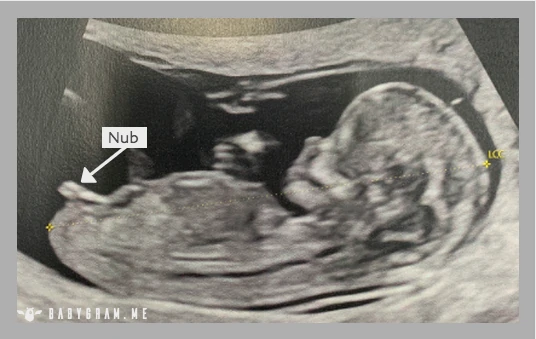
This genital tubercle of your child will grow into a penis or a clitoris defining their gender. Mostly, you can see it happening during the second trimester of your pregnancy. Ask your physician about it if you're expecting to go in for your 20 weeks' autonomy scan.
That said, if you are in the earlier stages of your pregnancy, the Nub will look the same in shape and/or size whether your baby is a boy or a girl.
The Difference between the Genders
Are you wondering how you can tell if it is a boy or a girl in a scan? The answer is simple, i.e., a boy's Nub will be pointing out in a different direction than a girl's Nub.
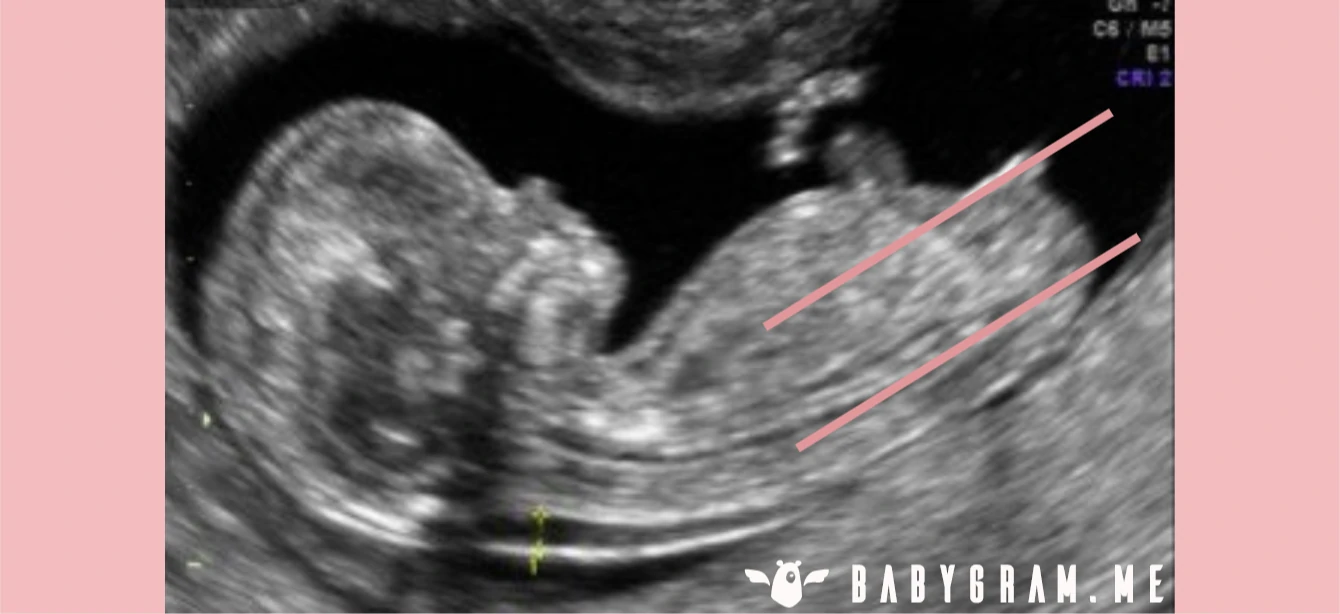
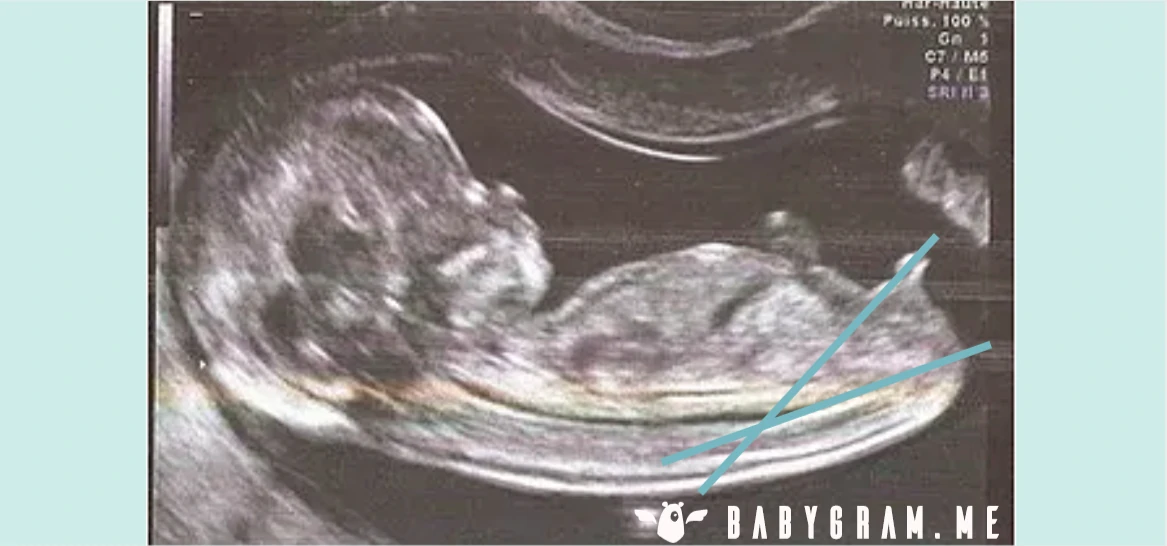
If you are expecting a baby boy, the Nub will angle upwards. On the other hand, if you are going to have a girl, the Nub will lie down flatter. Hence, another un-formal yet witty term used for nub theory is "the angle of the dangle" that reveals if the fetus inside you is a boy or a girl.
Variation of the Angle of the Dangle
The nub theory relies on analyzing the angle between your baby's spine and the Nub. Here is a short description of the variation.
- It's a boy! - if the Nub forms a 30-degree angle or more in relation to the spine.
- It's a girl! - If the Nub is pointing straight out, forming an angle under 30 degrees in relation to the spine.
Is Nub Theory Reliable to Determine Your Baby's Gender?
The nub theory first appeared in medical literature in 1999, when Efrat et al. published their landmark study in Ultrasound in Obstetrics & Gynecology (PMID: 10380292), demonstrating 71.9% accuracy at 11 weeks rising to 99% at 13 weeks. A 2001 longitudinal study by Mazza et al. in Ultrasound in Obstetrics & Gynecology (PMID: 11422974) confirmed these findings, and further validation came from Whitlow et al. (1999), Lev-Toaff et al. (2003), Mazza et al. (Prenatal Diagnosis, 2004), Efrat et al. (2006), and Youssef et al. (2011). Overall, the scientific evidence from 11+ peer-reviewed studies shows nub theory is a reliable method when performed after 12 weeks of gestation with clear ultrasound images.
Dr. Zeev Efrat, the pioneer of nub theory research at the Rambam Medical Center in Haifa, Israel, established that the angle of the genital tubercle relative to the spine is the key predictor of fetal sex. His 1999 study with Professor Kypros Nicolaides at King's College London laid the scientific foundation that all subsequent nub theory research builds upon.
That said, the average reliability of the nub theory currently stands at more than 90 percent. However, it depends on the following conditions.
- You must get a scan after 12 weeks of your initial pregnancy diagnosis. This is also 14 weeks since your last menstruations.
- The fetus size must be greater than 60mm
- The ultrasound image must reveal the entire Nub
Although, the method is not 100 percent reliable if you get an ultrasound before 12 weeks of pregnancy. Why? Because the Nub will not be clearly visible until the 12th week so hold your horse and let the thing come out of its shell.
It is imperative for you to know that the nub theory prediction's accuracy rate will highly depend on the expertise of the physician or healthcare professional.
According to an ultrasound technician, she only got the gender wrong once in her 25-year career. (Unfortunately for her, it was her best friend's baby, so she will never escape that party joke).
Some healthcare technicians and professionals even admit not to dare reveal the prediction because they are not too confident about the nub theory. This is why BABYGRAM experts have to take a test to check their abilities and experience to provide reliable predictions for expecting mothers.
It Can Be Tricky to Predict the Gender
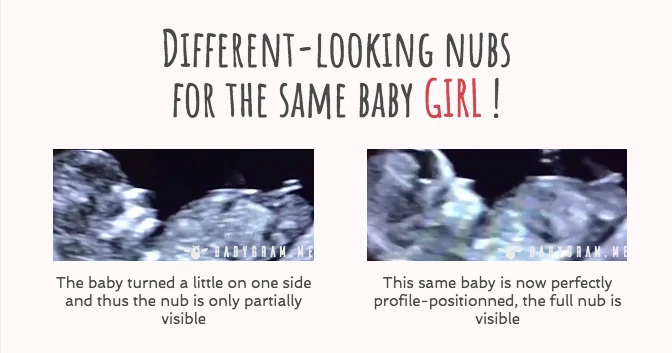
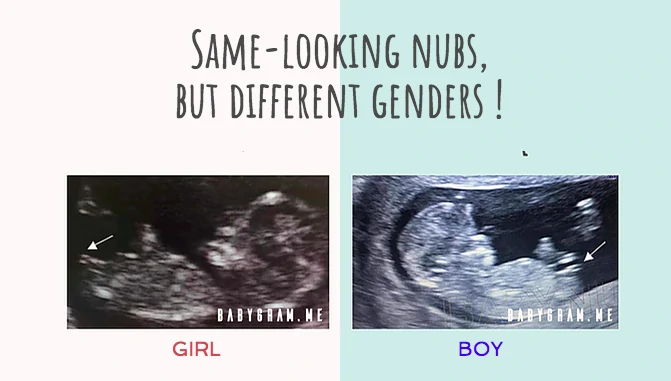
Sometimes the nub theory struggles to predict the gender of your baby. This is when the Nub shows two different angles in different positions. One picture of the baby's fetus may show a nub of a boy, whereas a picture taken from a different position may suggest it to be of a girl.
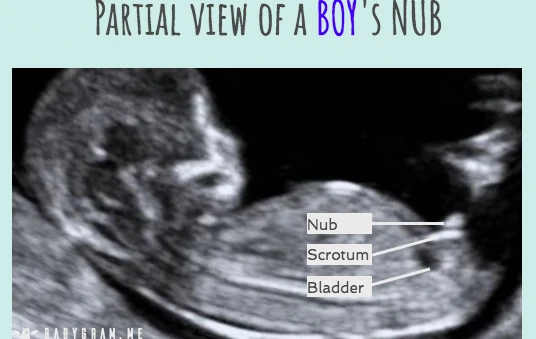
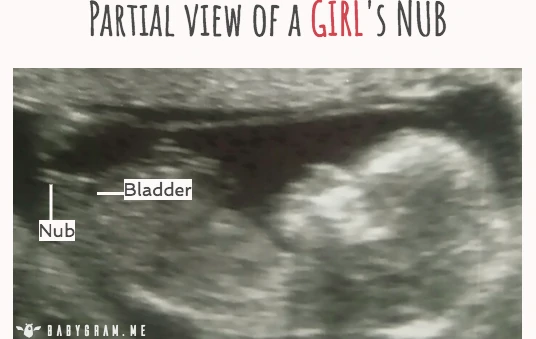
Same baby, two nubs! Yes, a girl and a boy can have a nub of the same appearance! See the examples below, which are great classics of cases that are very difficult to identify.
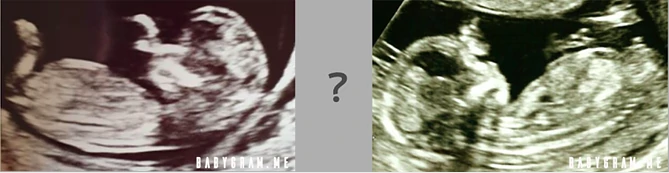
What's more, you cannot even see the Nub at all, or its appearance is of no particular gender, as shown in the photos below.
Boy or girl? Predicting the sex in such cases is a 50/50 game at best.
You must also remember that a nub analysis before 12 weeks of pregnancy, especially for fetuses smaller than 60mm, may be inaccurate. A flat nub indicating a girl may rise after 12 weeks of pregnancy and finally show a boy!
How BABYGRAM Can Offer the Most Reliable Baby Gender Prediction Online
BABYGRAM can give you a reliable prediction of your baby's gender. Experts at BABYGRAM use the nub theory to thoroughly analyze your ultrasound and prove 99 percent accurate results on your baby's gender.
What if you cannot see the Nub?
No worries, at BABYGRAM, we use a unique technology to compare your ultrasound with over 10,000 reference images to deduce the gender of your unborn baby. In such cases, BABYGRAM has a track record of providing a reliable prediction of 85 percent accuracy from just nine weeks of pregnancy.
Our Artificial Intelligence algorithm, the foundation of the technology at BABYGRAM, is currently with reputable scientific journals. After a peer review, it will be up for publication in the coming future.
Are you excited about discovering your baby's gender? Learn more about our method, or order your ultrasound analysis now!
Nub Theory Accuracy by Gestational Week
The accuracy of nub theory depends heavily on gestational age. According to peer-reviewed studies, the prediction reliability increases significantly week by week:
| Gestational Week | Accuracy | Source |
|---|---|---|
| 11 weeks | 71.9% | Efrat et al., 1999 |
| 12 weeks | 92% | Whitlow et al., 1999 |
| 13 weeks | 98–99% | Efrat et al., 2006; Youssef et al., 2011 |
| 14+ weeks | 99%+ | Fully differentiated |
These accuracy rates require clear ultrasound images where the full genital nub is visible in a sagittal plane. According to Mazza et al. (Prenatal Diagnosis, 2004), external genitalia differentiation follows a predictable biometrical pattern that becomes increasingly reliable after 12 weeks.
Nub Theory vs Other Gender Prediction Methods
How does nub theory compare to other methods of predicting your baby's gender? Here's what the science says:
| Method | Accuracy | Earliest Timing | Scientific Basis |
|---|---|---|---|
| Nub Theory | 72–99% | 11 weeks | 11+ peer-reviewed studies |
| NIPT Blood Test | 99%+ | 10 weeks | Clinical standard |
| Anatomy Scan | 95–99% | 18 weeks | Clinical standard |
| Ramzi Theory | ~50% | 6 weeks | 1 unverified study |
| Chinese Calendar | ~50% | Any time | Folklore |
| Skull Theory | Unproven | 12 weeks | No studies |
The Empowering Aspect of Nub Theory
For many parents, the nub theory offers more than just a sneak peek into their baby's gender; it provides a unique opportunity for early bonding and preparation. Knowing the gender ahead of time allows families to personalize their preparations, from nursery decorations to choosing a name, thereby making the pregnancy experience more engaging and emotionally enriching. Additionally, for parents who have specific medical or psychological reasons for wanting to know the gender early on, the nub theory can offer valuable peace of mind. As we move into an era where personalized healthcare is becoming the norm, the nub theory stands as an example of how medical science can cater to individual needs and preferences, enhancing the overall experience of pregnancy in a meaningful way.
The Democratization of Gender Prediction through Nub Theory
One of the most compelling advantages of the nub theory is its accessibility. Unlike some other gender prediction methods that may require advanced imaging technology or invasive procedures, the nub theory relies on standard ultrasound images that are part of routine prenatal care. This makes it a more affordable and less risky option for a wide range of expectant parents. Furthermore, the rise of online platforms specializing in nub theory analysis means that even those without immediate access to specialized healthcare professionals can still benefit from this method. By democratizing access to early gender prediction, the nub theory serves as an equalizer, offering more families the joy and excitement of early gender discovery, regardless of their location or socioeconomic status.
Frequently Asked Questions About Nub Theory
What is nub theory and how does it work?
Nub theory predicts baby gender by analyzing the angle of the genital tubercle (the "nub") visible on ultrasound between 11–14 weeks of pregnancy. If the nub angles upward at 30° or more from the spine, it suggests a boy. If it's parallel or angled downward, it suggests a girl. This method is backed by multiple peer-reviewed studies, including Efrat et al. (1999) published in Ultrasound in Obstetrics & Gynecology.
How accurate is nub theory at 12 weeks?
At 12 weeks, nub theory is approximately 92% accurate according to Whitlow et al. (1999). Accuracy improves to 98–99% by 13 weeks (Efrat et al., 2006). The key factors are image quality, fetal position, and the sonographer's ability to capture the nub in the sagittal plane.
Can nub theory be wrong?
Yes, nub theory can be wrong, especially before 12 weeks when accuracy drops to around 72% (Efrat et al., 1999). Common causes of incorrect predictions include: the fetus being too small (<60mm), poor image quality, the nub not being fully visible, or the fetus being in an unfavorable position during the scan.
What is the earliest you can use nub theory?
Nub theory can be attempted from 11 weeks of gestation, but accuracy at this stage is only about 72%. For reliable results (92%+), it's recommended to wait until at least 12 weeks, when the genital tubercle has developed enough to show a clear angle. At 13+ weeks, accuracy reaches 98–99%.
Is nub theory more accurate than Ramzi theory?
Yes, significantly. Nub theory is supported by 11+ peer-reviewed studies with accuracy rates of 72–99% depending on gestational age. Ramzi theory, by contrast, has never been replicated in peer-reviewed literature since the original 2011 publication, and independent studies found it to be no more accurate than chance (~50%).
Does nub theory work with abdominal ultrasound?
Yes, nub theory works with both abdominal and transvaginal ultrasound, as long as the image clearly shows the genital nub in the sagittal plane. Transvaginal scans may provide clearer images earlier in pregnancy, but standard abdominal scans at 12–13 weeks are typically sufficient.